1. The Fundamental Unit: The Qubit
In classical systems, information is stored as bits (0 or 1). Quantum systems use the qubit (quantum bit).
Mathematical Representation
A qubit exists in a state vector or wave function denoted as . It is expressed as:
- Basis States: and are the fundamental discrete states
- Amplitudes: and are complex numbers representing probability amplitudes.
Measurement and Duality
A qubit possesses a dual nature: it acts as an analog variable(any real number) before measurement (as and vary continuously) but becomes digital(0/1) after measurement6.
- Superposition: Before being observed, the qubit exists in both states simultaneously This is illustrated by Schrödinger’s Cat, which is considered both “dead” and “alive” until the box is opened.
- Probability: The probability of collapsing to is , and for is .
- Normalization: The total probability must always sum to 1 ()10.
2. Visualizing States: The Bloch Sphere
The Bloch Sphere is a 3D geometric tool where any point on the surface represents a pure quantum state11.
-
Z-Axis (Vertical): The North Pole is and the South Pole is .
-
X-Axis (Horizontal Equator): Represents the Hadamard Basis. is at the positive x-axis, and is at the negative x-axis.
-
Y-Axis (Depth Equator): Includes complex phases. (positive y) and (negative y).
-
General State: Defined by angles (latitude) and (longitude)15:
3. Quantum Gates
Quantum operations are represented by unitary matrices that rotate the state vector on the Bloch sphere.
Single-Qubit Gates
- X-Gate (Pauli-X): Acts as a bit-flip (the quantum NOT gate), mapping . It rotates the sphere 180° around the X-axis. e.g. If the input state is , the output becomes
- Z-Gate (Pauli-Z): A phase-flip gate. It leaves unchanged but flips the sign of (). It rotates the sphere 180° around the Z-axis.
- Hadamard (H) Gate: The most critical gate for superposition. it transforms basis states () into equatorial states ().
- S and T Gates: Phase-shifting gates. The S-gate rotates 90° () maps to and the T-gate rotates 45° () around the Z-axis.
Two Qubit Gates
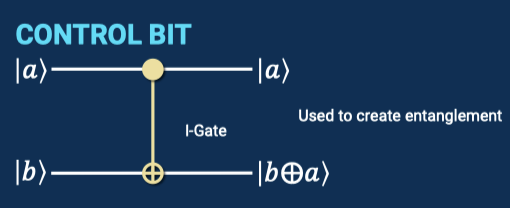
- CNOT (Controlled NOT): Flips the second qubit only if the first qubit is . This is the primary tool for creating entanglement.
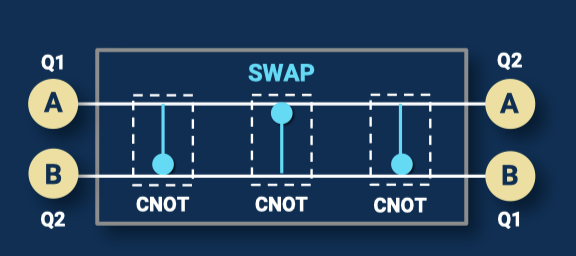
- SWAP Gate: Exchanges the states of two qubits, often implemented using three CNOT gates. It used to move qubits under restricted connectivity.
-
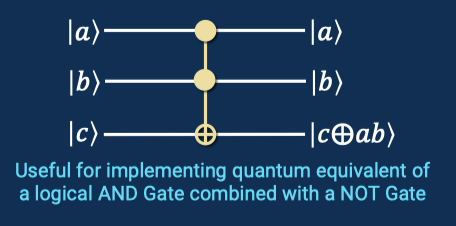
Toffoli (CCNOT): A three-qubit gate where the third qubit flips only if the first two are both .
-
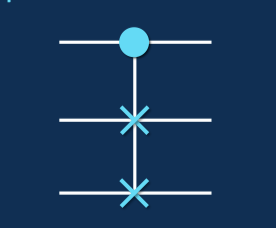
Fredkin (CSWAP): Swaps the second and the thrid bit iff the control bit is
4. Governing Principles
Quantum computing is restricted by laws that do not apply to classical systems.
Reversibility
All quantum operations must be reversible; information cannot be destroyed. If you have the output state, you must be able to mathematically reconstruct the exact input state.
No-Cloning Theorem
It is physically impossible to create an identical, independent copy of an unknown quantum state.
- Entanglement vs. Copying: Using a CNOT gate on a qubit and a blank qubit results in entanglement, not a clone.
- Teleportation: You can transfer a state to another qubit, but the original state is destroyed in the process